On Pause

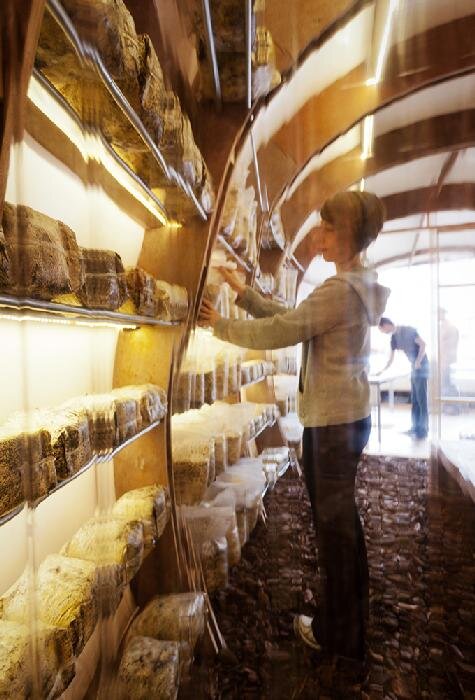
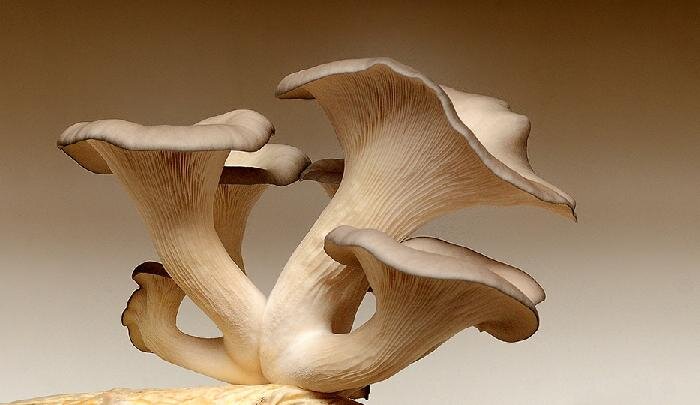
Tending to the baby oyster mushrooms

Tending to the baby oyster mushrooms – photo by Kevin Scott

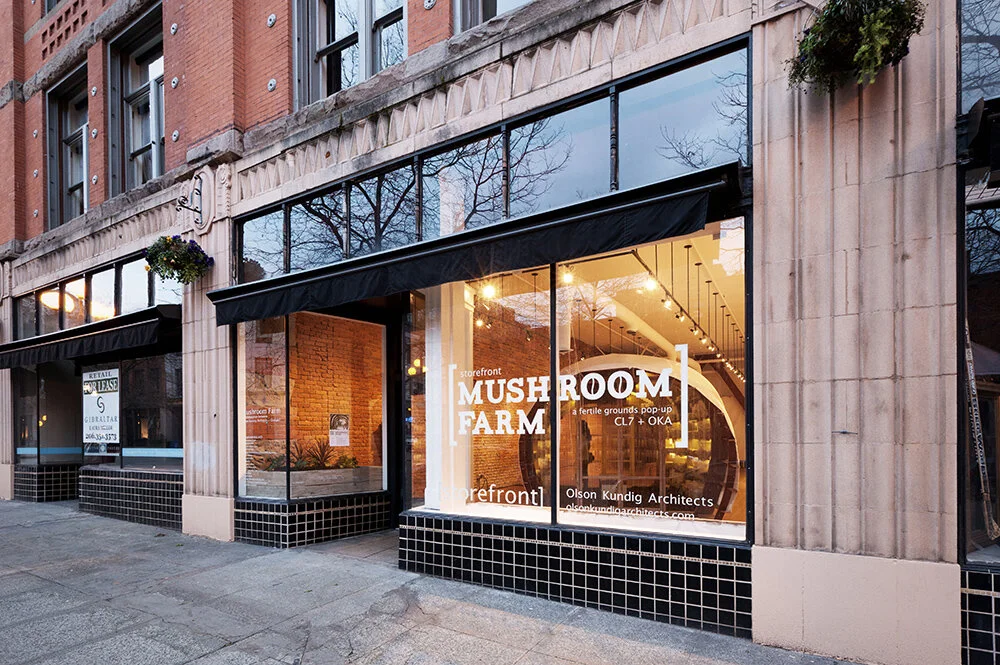
A few weeks ago, I spoke with Maggie Kaplan, founder of Invoking the Pause, the environmental small grants program that funded my CityLab7 partners and I in the ideation and development of our urban mushroom farm.

It’s been a year since our installation closed, marking the end of a long-term project fed by buckets of sweat equity and three grants. Each of us in CityLab7 came from different educational and professional backgrounds and sought diverse outcomes from our involvement, from the desire for like-minded collaborators and a creative outlet to the opportunity for new business entrepreneurship. During those three years together, our needs and relationships grew and changed in ways that often surprised me.

The alternating rhythms of challenge and delight inherent to our Pause experience were truly life-changing. Much of it had to do with the immense freedom that we were granted as creators, and how we as a group reacted to that freedom. It was difficult to fully understand the impact of The Pause in the moment, though; I was in a mode of prospecting the entire time.

When Maggie encouraged me to investigate the impact of The Pause on my life today, I found that I finally had enough distance to do so.

Though we became a formal collective in 2009, our cohort actually came together in 2008, months before we found Maggie’s call for proposals on the Bullitt Foundation website. CityLab7 took its first Pause on a ferry ride to Bremerton during a temperate September afternoon, leaving early from work so that we could spend time together. We were all prospecting back then, with no idea what we would find, nor that our efforts would result in anything as tangible or successful as they did.

With that, I’ll direct readers to the blog post that I created for Invoking the Pause, which describes the lessons learned and the wandering path that led to the birth of our mushroom farm brainchild.

The story begins here.


Sabrack’s Rules to Live By

This spring has become an informal lesson on the craft of writing, thanks to several books including Bird by Bird by Anne Lamott. (In case you’re wondering, my next read is an illustrated version of Strunk and White’s Elements of Style recommended by Karen Maeda Allman of Elliott Bay Books.)

For the first Saturday evening in months, I stayed in last night simply to read. It was brilliant.

Tucked inside a broken-in nook on my microsuede green sofa with a heavy throw and a cushy pillow on a cold, blustery night, I couldn’t help but laugh at the chapter titled, “Radio Station KFKD.” In it, Lamott warns,

I need to bring up radio station KFKD, or K-Fucked, here….

If you are not careful, station KFKD will play in your head twenty-four hours a day, nonstop in stereo. Out of the right speaker in your inner ear will come the endless stream of self-aggrandizement, the recitation of one’s specialness, of how much more open and gifted and brilliant and knowing and misunderstood and humble one is.

Out of the left speaker will be the rap songs of self-loathing, the lists of all the things one doesn’t do well, of all the mistakes one has made today and over an entire lifetime, the doubt, the assertion that everything that one touches turns to shit, that one doesn’t do relationships well, that one is in every way a fraud, incapable of selfless love, that one has no talent or insight, and on and on and on.

Where was she when I needed her in college? Flipping to the front, I noted the copyright date: 1994. Smack dab in the middle of my college years. Ah, well.

In all honesty, Lamott’s work never had a chance of making it on my required reading lists. My science professors at The University of Arizona were addicted to the journal Nature, and my medieval literature profs preferred dusty white papers to contemporary books on craft.

If she had published Bird by Bird a few years earlier, Lamott and I might have met. My high school English teacher, Jeannie Sabrack, was the kind of writer –and the kind of woman– who would have brought Lamott’s book to class as an extension of her own life-and-writing lessons.

Mrs. Sabrack was the kind of teacher everyone loved because she told the truth. I was lucky enough to study with her nearly every semester of high school, since she taught senior capstone classes as well as beginning and intermediate composition. We also liked her because she didn’t dress like other teachers; she wore leather jackets, off-the-shoulder tops and high heels, the kind of clothing we thought writers –legit artists– wore.

To those of us who stayed with her for four years, she passed along life lessons that other teachers didn’t dare confide. She talked with us like the cosmopolitan friends that we assumed she had: ones who smoked cigarettes on her back porch, staying up late drinking red wine and sharing stories about adventures they had at 2 a.m. in Paris and London.

One crisp January afternoon, while comparing doomed relationships –Heathcliff and Catherine, Romeo and Juliet– she tossed a dog-eared copy of Shakespeare across her desk where it skidded into a pile of papers that needed grading.

“Let me just stop here and say something about sex to all of you young ladies,” she began.

I was sixteen at the time, and I didn’t know much about sex, since I hadn’t done it yet. It was the middle of my junior year; my mother had died a month before during Christmas break.

My mom wasn’t someone who I asked direct questions of anyway. Unlike Mrs. Sabrack, my mother didn’t give spontaneous advice, either –we weren’t the kind of family who did things that put us in advisory roles, like travel or read political magazines — but she did tell wonderful stories. “Tell me about the first time you fell in love,” I’d say while curled up in her lap, and off she’d go, a living memoir.

My early teens were fraught with intense mother-daughter struggles on top of her terminal cancer, so losing my virginity was the farthest thing from our conversations. Still, I had tons of questions that the bullshit sex-for-teens book with paper doll figures that my parents gave me didn’t come close to answering, but I couldn’t ask her. Not the way I wanted to, at least.

Then she died.

Naturally, I found myself leaning forward in Mrs. Sabrack’s class that day. She knew she had our attention, so she sauntered back to her desk, using her arms to push herself to sit on top of it. She crossed one black-stockinged leg over the other, swinging them back and forth as she adjusted her striped boat-neck top on her shoulders.

“Here’s the thing, ladies,” she said, conspiratorially. “We’ve read these books for the last three years, and they essentially get at the same thing, right? The struggle for this one important moment?”

Our heads bobbled silently with agreement. Even the boys were intrigued.

“Meanwhile, your parents and teachers are cautioning you to wait. There is all this build-up about a single act. Heavens will tremble, horns will blare. You’re wondering what it will mean. Suddenly, your lives will change, but you can’t guess how. People have written and will continue to write about THIS VERY THING forever.”

She paused to sip coffee, torturing us. “Let me tell you,” she continued. “You’re going to do it eventually, and all of you girls are going to think, ‘THAT’s it? THAT is what my parents were so scared of me doing? THAT is what inspires poets to write sonnets? THAT is why Romeo and Juliet killed themselves?”

“It’s not, by the way,” she added as we broke out into boisterous laughter. “Those stories are about love, and you’ll discover that sex can be –and often is– something different. Sometimes, like the first time, it ain’t great. The truth is, the physical act itself is Not. A. Big. Deal. The build-up will feel like a lie.”

She leaned back, waiting for us to quiet down. “I will also say this: ladies, when everyone figures out what they’re doing, sex can be totally amazing. Love –and the physical expression of that love– does inspire poets. One day, if you’re lucky, you’ll find yourself saying in a very different way, Oh, THAT is what she was talking about.

I scanned the room to see which girls nodded, wondering if any understood her truth for themselves.

Four months later, I spilled my own realization into the receiver of our house phone. I was more surprised by the banality of my first time than I was in shock over the significance of losing my virginity that day after school.

“She was right!” I exclaimed with disbelief to my best friend. Jackie, who went to a different school, had never heard any of Sabrack’s Words to Live By, as her advice and prognostication was known. “After it was over, I thought, THAT’s it?! just like she said.”

Jackie reflected on her own first time, which had occurred the previous fall. “Now you know what I mean,” she sighed, relieved that I finally understood the joke whose punchline she silently carried. She had been tight-lipped about her experience, much to my chagrin; now I knew why.

Our inexperienced bodies and minds simply aren’t in sync at sixteen. An adult wrote Romeo and Juliet, after all, not a scramble-headed teenager fueled with uncontrollable lust. It took decades of maturity for Shakespeare to accurately portray the physical and mental urgency of teenage love.

Like most, it was a lesson I would learn over and over again myself, rediscovering that the act alone was as lackluster as Mrs. Sabrack foretold, leaving a trail of “THAT’s it?!” surprisingly far into adulthood. When I finally experienced the other THAT‘s it!, a little grin played on my lips. Snuggled against my boyfriend that night, I recalled Mrs. Sabrack’s prophecy as I fell asleep.

The woman knew of what she spoke, both literature and life.

At the beginning of my senior year in college, when I changed my major from molecular and cellular biology to English, I wrote to Mrs. Sabrack for advice. As with sex, my parents had always cautioned me away from seeking a career in literature; science was much more lucrative, they insisted. I had no one to turn to, so I wrote to say what a strong influence Mrs. Sabrack had on my love of writing and language. I mused about becoming an English teacher like her so that I could help students like me.

A few weeks later, I received her affectionate but staunch response: “I’m glad that you’ve found your way back to writing; I always enjoyed having you in class. As for following in my footsteps, you’re much too talented a writer to ever become a teacher. Best of luck.”

I was crushed. In the end, I graduated with a degree in English and went to work for a real estate developer who admired my writing skills. I embraced business and left a full-time writing career behind, albeit with regret.

With Lamott’s book in my hands eighteen years later, I feel like I’ve rediscovered Mrs. Sabrack’s voice, only this time, I understand her wisdom firsthand. I’ve lived through enough attempts, rejections and small achievements to see pin-pricks of light on the path ahead. When Lamott comments that commercial success and critical acclaim don’t solve everything –that devotion and commitment to writing are their own reward– I get it.

It’s not so bad receiving this message today instead of at twenty-one. Like sex at sixteen, I wouldn’t have had the life experience to absorb Lamott’s advice in college. Writing as an outside interest from work has afforded me the freedom to pursue what I am passionately interested in.

That said, a push to pursue a master’s in creative writing back then would have set me on a different path, arguably a more direct path to a life steeped in craft and fellow writers, like those I’ve met through Jack Straw or Artist Trust. I might have become a graduate teaching assistant and then a freelance writer, or an administrator at a non-profit like Richard Hugo House. My earning power would have been diminished, as my parents feared, but I might have fulfilled dreams that are, as of yet, unchecked.

Maybe I would be a better or more accomplished writer today had I immersed myself in that life. Like many writers I know, I might have spent my thirties co-hosting an open mic series or growing a network of published authors who could write blurbs for me and hook me up with their agents.

These second-guesses creep in as they have since high school (and long before that), only now because of Anne Lamott, I see that they only arise when my dial is tuned to KFKD.

Yes, all of those things could have come true and I’d likely still find myself sitting here on my green couch with my feet on the ottoman wondering, “THIS is it?!” Instead of literary accomplishment, I’d fret about other deficiencies, like why my 401(k) was so small or why I couldn’t afford to travel.

Having Lamott’s book on my shelf means that I can not only return to her wisdom, but to Mrs. Sabrack’s, when I need a reminder. (Unlike Bird by Bird, Sabrack’s Rules to Live By was never written down. She would have been on probation if our principal had evidence of what we learned from her.) No matter who we are or what we write, most of us can’t be reminded of life’s truths enough.

If I had a class like Mrs. Sabrack did, I’d confide to my students that there is no such thing as a clear path, especially for writers. Determination can lead a person far –it can feel like a map– but the road is always clearer in retrospect. If we’re lucky, life is a wandering journey that brings us to people and experiences that we might never have sought if left to our own greedy sense of expediency and achievement.

If we’re doubly lucky, and a little wise, we can learn from these adventures without sabotaging or judging our own progress like the disc jockeys on KFKD.

As Lamott’s father instructed, we should take each turn in the road as it comes, bird by bird (go ahead, buy a copy – it’s worth it), like those oft-quoted lines from Robert Frost, which are oft-quoted for a reason:

Two roads diverged in a wood, and I–
I took the one less traveled by,
And that has made all the difference.


The Power of Three

It was nearly a year ago that I first visited Boston. Last week’s events had me rereading my Boston essays, reflecting on my time there and the people I met, like Maya, my airbnb hostess whose South End home I shared, and Joseph Janezic, the assistant DA for the gang crimes unit.

As I listened to the unfolding plot on NPR, I wondered how the bombing affected their week. Was Joe spending extra evenings at community meetings with families in Dorchester, or was he pulled over to assist in the investigation? Did Maya stay closer to home, or did she maintain her public routines in quiet defiance?

I thought about my friend John who lives in Waltham with his wife Enrica and their son William, who speaks only Italian. If such a task were placed in my hands, could I explain terrorism in Italian to a four-year-old? It’s difficult enough to distill tragedy into simple terms in English, though events like these are never easy to explain, no matter the language.

For a case that officials kept promising would be painstakingly slow, the manhunt unraveled quickly, most of it playing out for me on Twitter rather than TV, newspaper or even radio. On Friday afternoon, the Twitterverse read like a scrambled conversation between a police scanner, a philosopher, a news anchor and a comedian:

Breaking news: Boston suspect remains at large; lockdown is lifted.

The brothers did not rob the 7-11, police just confirmed.

Boston police captain says MIT cop was “assassinated in his cruiser.”

“We cannot continue to lock down an entire city” – Boston lifts its ‘shelter in place’ order as manhunt continues.

Boy killed at Boston Marathon was son of injured school librarian.

We men know, among the men we know, which of them would turn into monsters during an apocalypse.

BREAKING: Source says bomb suspect pinned down in Watertown.

Never before perhaps in the history of #america has a #teen had so much #power #manhunt #boston I’m betting he felt v powerless before…

The suspect is alive, surrounded and still moving.

Half truths everywhere.

I’m guessing Dzhokhar isn’t going to be a popular baby name this spring.

BREAKING NEWS: Police have taken the cover off the boat containing the man believed to be the Marathon bombing suspect. He’s not moving.

Two happiest days in a man’s life are the days he buys a boat and the day a suspected terrorist gets blown away in it.

There is a shameful level in a dark place in your soul that is currently thinking, “It doesn’t get cooler than this.”

Latest from Watertown, Mass, where local media report that Marathon bombing suspect may be surrounded.

This is the moment when Cheech and Chong emerge from the boat, coughing.

We are preempting @ThisAmerLife tonight to stay with continuing NPR coverage from the search for the second bombing suspect in Boston.

CNN reporter on the scene says police are yelling at person in boat “come out with your hands up, come out on your own terms.”

Hold on; I have to imagine I can afford a boat first. OK, I’m ready. RT@piersmorgan: Imagine if that’s YOUR boat. #CNN

They got him!

And now I’m closing my eyes and sinking into halcyon reverberated ballads circa ’61 to shield my sanity.

Lots of cheers breaking out, started by the officers.

Breaking news: Boston bombing suspect is in police custody.

Suspect in custody. Officers sweeping the area. Stand by for further info.

Good work, BPD. And hey, someone’s boat just appreciated.

Twitter is more than glitter. #citizenjournalism

Spooky RT@streitfeldcnn: A UMass source confirms that on Weds Tsarnaev went to the campus gym + spent the night in his dorm room.

Map: See where the second Boston Marathon bombing suspect was arrested.

Two police officers involved in Boston manhunt, one dead and another fighting for his life, met in police academy.

We were looking for a man and then we found a man, and heaven knows we’re miserable now. #manhunt

Heaven knows indeed. After that, my Twitter feed lapsed into a cascade of cute otter photos, advertisements for open mic events and NaPoMo poems of the day. The world became a seemingly sane place again—one bomber dead, the second apprehended—after which our fickle attentions searched for milder distraction.

Feeling the lag of the media buzz, a young social media guru attempted to whip followers into an echo frenzy (Someone needs to tell the tv news that lots of people died in West Texas!), but no one responded. Like any drug, there’s such a thing as too much, and the shelf life of the tragedy had run out. It was the weekend, after all, and 9/11 has set the bar for catastrophe in North America—as well as the endurance of American reaction to it.

Early in the week, someone commented on NPR that the Boston Marathon bombing was undoubtedly a home-grown act of terrorism rather than one of Al Quaeda, noting that they draw recruits with the possibility of creating great, not small, chaos:

“Only three people dead and one of them a child? An event of this magnitude would not give a group like Al Quaeda anything to brag about, especially after the grandeur of the World Trade Center and the Pentagon.”

Although saddened by news of the bombing, 9/11 has raised my threshold of alarm, without a doubt. I skipped over what seemed like a melodramatic reporter saying the he had never seen anything like the marathon bombing, noting the small puff of smoke on TV and video that showed runners continuing to cross the finish line after it blew. Right or wrong, when compared with the devastation of the twin towers, it was difficult to feel for this what I felt for 9/11.

The speed at which we receive and process information these days encourages us to be unaffected. How can we stop to mourn three people when we are distracted by the gun control debate, immigration reform and 35 dead in Texas? Conversely, how did we effectively miss those 50 injured and 35 dead from the fertilizer plant explosion, nearly a third of whom were first responders struggling to get civilians to safety?

To the young Twitter maven’s point we, as a nation, did skip over that tragedy in favor of the manhunt, which provided a dynamic, ongoing plot. Either way, tragedy shouldn’t be a contest.

I felt a little cheap for circling over the scene in the helicopter of my Twitter feed, casually retweeting and starring posts with the flick my finger. Some posts I shared as a means of spreading information, others as entertainment. The speed of Twitter —of any modern media, really— is unforgivably forward-moving. Moments of sadness and poignancy drift in a wash of crass (and sometimes clever) humor, sensationalized headlines and celebrity shout-outs. When compared with the power of social media to gather and organize protests in Egypt, ours seems candy-coated.

Though they benefit us in many ways, modern media channels demand that we be as removed as the sources of our news itself. Smart phones in hand, we stare, blink and eat another handful of chips until the next calamity unfolds to entertain us.

In response to my own social media addiction (alas, I am no better), I’ve recently become attracted to memoir. The thing about books, and memoir especially, is that they allow the reader to sit with another human being for a spell. The pace at which we read, the nights that we spend propped up with someone’s life in our hands, provide a means of connection that simply cannot be achieved when standing against a raging river of 140-character updates.

We hear the author’s voice in our heads and think of where we were at the same time in our own lives. Memoirs are opportunities to mind-meld with the intimate thoughts of another human being, containing admissions that are typically too complex or revealing to be captured in a live broadcast. They have the power to inspire our oft-misplaced empathy, encouraging us to wonder how we might have survived the author’s circumstances of love, loss or adventure.

For days or weeks at a time, we become fire fighters cut off by burning forests, women who hike remote trails in search of themselves, survivors of genocide and presidents who make impossible decisions for the good of a people, most of whom they will never meet.

With the gentle unfolding of a person’s life, memoir reveals the human in all of us, reader and writer alike. Personal stories remind us that, yes, even in the midst of Syrian rebels and exploding fertilizer plants, three people dead is always worth stopping for and caring about—especially today.


Waves

The beige receiver felt heavy in my hand as I dialed. The phone rang several times before my mother picked up.

“Good morning, Constitution Elementary.”

“…Mom?” I whimpered.

“What’s wrong?” she demanded without saying hello. “Are you okay?” My voice had caught her by surprise. It was 9:15 on a Thursday morning and I should have been in class.

“Yeah, but I did something…bad.” I twisted the phone cord around my index finger until the tip started to turn red. “Mom, I cut my hair.”

“And…?”

“And I can’t leave the house.”

“What?! You’re not in school right now?” I had never been late to school a day in my life, let alone skip class.

“I know, I just… My hair was all wrong this morning. I couldn’t get it to curl, so I thought I would trim the side that didn’t look good.”

“And?”

“Well, I trimmed too much on one side, so I tried to trim the other to match, but I couldn’t see all the way around. I figured that I could still even it out, so I kept cutting and now I’ve cut off, like, four inches on the left side and it goes up even farther in the back. Please, Mom, I can’t go to school like this!” I pled.

She was irritated since she had to take time off of work to get me, as well as call school to excuse my absence. She sighed and shook her head when she saw what I had done, trying hard not to laugh, as I was taking the whole thing so seriously.

“My junior high graduation photos are going be ruined,” I insisted, when Alison, her hairdresser, evened up my hair all around. “And I look like a boy.”

“Sorry, honey, you only have yourself to blame on this one,” Mom said, putting her arm around me as we walked out.

Since then, I’ve come to realize that, if one thing unifies all women, it is not motherhood or menstrual cramps—it is our collective struggle with hair. Seriously, have you ever met a woman who was happy with her hair in its natural state?

Look in any woman’s medicine cabinet and you’ll find an array of products that she has tried over the years —curl enhancer, smoothing infusion, deep conditioner, hairspray, gel, pomade, hair color— not to mention blow dryers, curling irons and thousands of hair clips and accessories. On top of it, there is the perming, tinting, foiling, baliage, chemical straightening, extensions and other insane what-not that she pays a stylist to do to her every month.

In spite of all this, I’ve heard that the hairstyle one adopts in adulthood reflects the happiest time in a person’s life. (I’m not sure this applies to men, though, as their hair looks the same from age twelve. This either indicates the age that they revert to emotionally, or perhaps a rubicon perpetually unmet.) In any case, we women wander, follicularly and otherwise, over the course of our lives, led by complex emotions and indoor plumbing as much as ever-changing hairdos.

For those of us who explore style after style, does that mean that there was never one “happy” time we can fall back on?

Things were fine for me until age six. Before then, we lived in Michigan and my mother let my strawberry brown hair grow out in large tousled waves with blunt-cut bangs. In every photo from this time, I am smiling. This was not the case after we moved to Phoenix. After our first summer, my mother thought that my long hair would be too hot, so she asked Alison to shear it without consulting me first.

I walked into the tacky beauty shop looking like Brooke Shields and walked out a very disgruntled Dorothy Hammill. That’s when we learned that cutting wavy hair like mine creates an unruly nest.

At first, my mother was more sorry than I was, since she felt obliged to style it for me. Each morning, she blew it dry and curled the ends so that they didn’t stick out so badly. Around age nine, it became my battle.

As if the blow drying and curling weren’t enough, I also had light brown hair, which was a no-no in Arizona as all of the popular girls had straight blond hair. Given the number of my fellow brunette students, the Phoenix metro area must have seen record sales of Sun-In during the 80s as we all walked around with brittle orange-blond split ends.

The years that followed were no better. During high school, I tried perming my hair to control the wave; in college, I paid stylists to add blond highlights. Through it all, I could never get my hair to sit smoothly, so I began straightening it with a flat iron every morning. By my early 30s, my graduated bob was so blond and so straight that a friend teased, “So, which Desperate Housewife are you?”

That comment was my bottom.

Looking at a photograph of myself, I couldn’t quite understand who was looking back: seemingly, a young woman with perfect hair—smooth, shiny and carefree. It couldn’t have been further from the truth.

For all the friends, co-workers and strangers who have complimented my hair over the years —many, as my stylists will confirm, since they get the referrals— most have no idea how hard I work for it. “Perfect” hair is a mask; people think they know who I am (serious, professional) and they think that my hair comes this way naturally.

The Desperate Housewife comment, combined with time-fatigue from my morning routine, prodded me to explore going au naturel a few years ago. There were some failed experiments where I tried to guide the outcome by using a curling iron to get more curl from the wave, since my hair was still too short for gravity to weigh it down.

“I like your new hair, Gabbi,” a principal at my old firm said the first time I showed it off. “It reminds me of my favorite piece of architecture.”

“Really? Which one?”

“Do you know The Bird’s Nest by Herzog & de Meuron?” he asked. His compliment was genuine. I came back the next day with straightened hair.

It wasn’t until I returned to Italy in August 2011 that I let it be. For three weeks, at least. It was so bloody hot and humid in Venice that I couldn’t fathom using my hair dryer or flat iron. Only as I prepared for the flight home did I apply straightening pomade and hot tools to tame my frizzy mane, sweating as my hair dried.

During those three weeks, I realized that I needed time to ease into my new/old self, and then just let it go. Allowing my hair to be crazy-wavy was how it worked best—the less primping, the better.

Since then, I let my hair go on humid days. I’m still surprised by how positively others react; they say everything from, “Your happy hair is back!” and “Why would you straighten it when it does this?” to “Now your hair matches your personality.” People are flabbergasted when they realize that the crazy wavy hair is the “real” me. It forces me to ask why I’ve spent so much time, money and effort trying to be someone else, even if in small ways.

We all do it. Think back to Marlo Thomas’ must-have That Girl flip or Jennifer Aniston’s famous shag, “The Rachel,” that everyone demanded from their stylists. One could argue that emulating movie stars or models is a normal part of growing up as a girl, but it doesn’t stop there. The line between fad and identity is thin.

On some level, it’s about not wanting to be ourselves. We emulate what society deems beautiful. We want to be loved and accepted. We fear rejection, thinking I won’t appear attractive/cool/professional enough if I don’t look a certain way. Altering one’s physical appearance to fit in does more than shape follicles; over time, it transforms collective perception, including our own, creating new —and some might argue false— personas.

Are we the altered person that everyone sees, or someone different inside?

For many years, I wore the skin of that Teutonic, straight-haired perfectionist until I realized that I had lost touch with the creative, wavy-haired brunette deep inside. More to the point, I was unhappy with carrying on that facade.

After a few years in Seattle, I bridged the gap back to brown hair (it looks better with my skin tone anyway), and when I feel like it, I go wavy. I often straighten my hair because I like the smooth and silky feel. Today, it’s less about looking like someone else and more about expressing what looks and feels good to me. Embracing the freedom and intention to reveal what’s inside on the canvas of my physical self is actually quite powerful.

In the end, it’s about feeling comfortable in one’s own skin. One day, the balance tips between the effort required to maintain a brand that we believe is more likable or successful versus running with what we were given, no matter how gray or wavy or eccentric it is.

Today, my hair is just long enough to pull into a teeny, tiny urban ponytail for the first time in twenty years. The purple streak that my stylist, Dan, added on the left side looks pretty wicked. Turns out, finding the right environment for living and working does wonders when it comes to growing a life in which you can express your true self.

Besides, the purple melds into my natural brown quite nicely.

I can’t say that I’ve reached my hair equilibrium yet —the reigning style that hearkens back to the happiest time in my life— but I like what’s going on at the moment. Who knows; maybe it’ll stick. Or maybe happiness is an evolution, and there will never be a stopping point.


Feet First

After wading through my firm’s annual marketing report and compiling an inventory of my own literary works for EDGE class this week, I sat down with the intent to write about report cards: the kind we give ourselves and others.

We are being graded all the time: by co-workers, partners, friends, people on the bus and our own consciences. Individually, we are known as the lady who holds up the line as she finds her wallet, the guy who turns in his assignments before deadline, the wife who leaves rings on the table with her coffee mug, and the man who wipes his nose with his hand. We are many things, including these physical habits, which become our defining if simplified descriptors — our brand, so to speak.

These perceptions create a report card over time. “I won’t ask William for this because he never answers my emails… but Jim does” becomes Jim:1, William: 0.

Most of the time, we grade others subliminally rather than actively, but some do keep score. I admit that I’m one of them, though my point spreads tend to be more gestural. Certain folks get a great deal of latitude, others a medium amount; those at the bottom better not be waiting for dinner, because they’ll starve.

This strata has evolved over time. I once gave away energy indiscriminately, mostly in the hopes of being liked or rewarded. I didn’t understand then that one’s energy and focus are finite resources, and that not everyone is equally deserving or appreciative. Getting older (and a bit more crotchety) has helped me become an unapologetic conservationist about who is served and in what order — As and Bs before Fs.

Today, those who score high are given access to a potent concoction of my energy and affection that is, to some degree, unlimited. They’re getting the good shit, and the fact that I have it to offer at all arises from that graduated delivery system. I’ve learned that I can’t run the fire hose at full blast all the time and expect to have any water left when I need to put out real fires.

With all this scoring, it’s gotten pretty crowded in my head over the past six months. I’ve rated myself on writing, the progress of my memoir, spending time with friends, applying for conferences and grants, as well as love, life, travel, money, career… That’s a lot of thinking about thinking, and a lot of scoring: win, loss, honorable mention.

While most of those categories bear high scores, that there are several that I rank null on, most of which are physical: yoga, sleep and walking. It’s not about points, but about the way I feel when I’m actively apportioning energy there. Right now, my body misses Flying Half Moon pose, sleeping until I wake up naturally (at least, on the weekends), and exploring the world with my feet and my senses.

On Friday, I met Lisa, the executive director of Feet First, through a mutual friend. We were supposed to meet for an hour, but it ended up being nearly two. We sparked immediately: two mid-career women geeking out about health, social justice, creative expression and the positive mental and spiritual effects of exploring the physical environment though the pedestrian experience. Our collective energies created an orange glow at the back of Caffe Umbria.

For some time, I’ve been brainstorming a new project centered on urban walks, so I left happily with neighborhood walking maps from Lisa, research fodder for a concept that needs to cook a while longer. Still, the idea of Lisa’s youth walks project left me super-charged. We had given each other a karmic boost, the kind that raised each of our energy levels.

Our exchange also made me consider how little I walk anymore. Right now, it’s mostly due to weather (and my wimpiness), but the rest is a result of time pressures. I’ve learned to trade off weekend exercise and fresh air for a few hours of work on grant applications, essays or blog posts. Last night, coming home from EDGE and the grocery store, I observed a family out for a sunny walk down Queen Anne hill. I considered joining them, but instead took advantage of the unoccupied laundry room, knowing that it’s nearly impossible to do wash on weeknights.

Of course it was free – everyone else was out walking!

“Walkies with Sean” in Ballard this afternoon will be the only outdoor exercise I’ve had in weeks. He is taking a yearlong sabbatical from work as he undergoes bone marrow replacement, including countless treatments to kill cancerous cells, wipe out his own tissue, replace it with donor tissue and regrow someone else’s DNA in his body. Thankfully, one way he can stay fit is by walking.

I’m always impressed by the pace we take on, as his oxygen capacity is so low right now. Still, I’ve got asthma, so we make ideal walking mates. I’m actually glad to have this chance to spend time with him, since he is first and foremost a bicyclist and I am not. Because we no longer work together, these walks are the most time that I’ve spent with him since I changed jobs two years ago.

Over the past few years, Sean has developed both a public and private writing practice. The public part, a blog on Caringbridge, began with writings about his daughter, who was battling leukemia. For two years, he wrote about her experience undergoing treatments similar to his own today. Not long after Sean set Louisa on her way (in terms of the blog – she is quite healthy now) he picked up the story of his own experience when his doctors informed him that he, too, had cancer.

Though we started out as co-workers for the same architectural practice, we rarely talk about architecture. I suppose that, in one way, we never did talk about design much. What I consider exceptional is the honesty and depth with which we’re able to talk today: about writing, about things and people who matter to us, and about our life experiences.

I’m continually touched by how freely and scientifically he explores this disease and his body’s reaction to treatment, both through writing and during our walks. For those of us whose lives have been touched by cancer, there is a common ground that we navigate gingerly; while familiar, I never presume that my experience is directly comparable with someone else’s. Hearing his perspective is comforting even if the subject matter is not.

Sean gives incredibly thoughtful form to feelings that would otherwise be impossible to guess at, even though I watched my mother go through something similar. The major difference was that she didn’t talk about it with me, or anyone. Sean’s words, on the other hand, are a rich offering: they encourage a free exchange of ideas, thoughts and feelings that galvanize our friendship.

For all of his stoicism, I am tempted to say, “Unlike me, Sean is not the sort to keep score.” While this is probably true, I won’t deify him. What I will say is that, much like the way he lives the rest of his life, Sean’s steadfastness in this is quite admirable. In fact, he typically appears so vital and jovial that I have to remind myself that he’s fighting for his life.

I don’t see him on weeks where he is ill from treatments or when he wears a surgical mask to protect himself at the grocery store (with a compromised immune system, he rarely goes anywhere that might be crowded with sick people, hence the walks in the open air.) The simple act of walking has become a key contribution to his health and mental wellbeing. Imagine being essentially stuck at home for months on end; it would drive any of us crazy, especially if we were as active as Sean. Most of us would spend our hours thinking a lot, perhaps a few of us would write, but we would need a way out, if only for a few hours a day.

Though our Walkies aren’t only about fun times, they are indeed that, too. Sean and I have well-developed funny bones (or perhaps irony bones?) In between earnest conversation, we tell stories about our families and ourselves, tickling each other with tales like two people just out for a walk.

To me, Walkies with Sean are a way to show how much he means to me, if in a small way. Except that we share something significant during our walks: we talk about what’s important to us. That’s the thing about cancer, or any adversity, really: it gives us pause to consider what matters most and where to direct (or redirect) our energies. It makes us conservationists of our assets and allies, not so much in the sense of score-keeping, but in maximizing the value and impact of all that is good around and inside of us.

Who knew that walking could be a means of becoming closer to someone?

From Jeanine Walker’s poetry-walk classes at Hugo House to Walkies with Sean to day-walks through places like Boston, Chicago and New Zealand, the act of walking has come to be a significant means of connection in my life. I once saw walking as a solitary activity, something one did when the car tires were flat or the bus left a minute early. Walking meant leaving or walking away rather than walking toward or with someone.

Thanks, Sean, for making sure that I get some outdoor playtime today. I’m ready to go, all in, feet first. See you soon.


The Baby and the Bathwater

“Sue, I’m gonna be blunt.”

My EDGE cohort and I were seated in a circle at the end of our second and final Saturday with writer Frances McCue, hanging on her every word. “You cannot give your manuscript to a writers group,” she advised. “They’ll murder it with good intentions, and it’s too precious. Now, here’s what you do…”

As we leaned in from our student chairs, the kind with wooden desktops at the arms, I wondered what she would have said had she been in the room fifteen minutes earlier.

The assault began innocently during a break-out group while we were refining our book pitches. I had revised mine significantly over lunch; it wasn’t quite there, but I was happy to share it aloud when she asked.

“Gabriela, that’s much better than your first draft. You’ve added some nice specificity.” As Frances left to check on the other group, I asked for feedback from the rest of the circle. I hadn’t noticed the hatchets of good intentions that awaited.

At first, their comments were helpful. Beverly honed on the link of the nine cities that I visited in nine months, a nod to gestation, which is relevant given my memoir’s focus on my mother. Judith suggested a gentle rearranging of thoughts into a clear by-line: “nine cities, nine months, a woman journeys in search of…” which I liked.

“What’s the title?” Patty asked.

“The working title is Hidden City Diaries,” I said, scribbling down their comments. I was distracted by the anticipation of bettering my pitch at home that evening.

“I’m not sure I really get what you mean when you say, Hidden City Diaries,” she said.

“When I first heard it, I wondered if it was some sort of tell-all,” Maritess commented.

“Yeah, me, too,” said March.

“I saw it as looking beneath a city, like maybe some sort of secret view underneath if you were going underground,” Jannat added.

Judith noted, “I thought it might be a nod to the Hidden City as in China.”

Without a moderator, the blood began to trickle. I was helpless to stop it.

“I’m wondering if you should change your title,” Patty mused. “After hearing you describe it, the title doesn’t really relate to the story you’re telling. It’s too vague.”

“Yeah,” Beverly agreed, “I’ve seen your website and I wasn’t totally sure what your book was about, either.”

“The title is really confusing; it makes me think that it’s about an affair or something.”

“And when you mention your mother’s victimization, do you mean that she was victimized by someone, like physically or sexually? Or what kind of victimization?”

“Also, you mention that your book ‘spans continents’, but can you give a specific list of places that you go? I think it would make your story seem more relevant to readers.”

“Maybe it’ll help if we hear more about how the book is set up. What’s the construct?”

“Well, it’s organized chronologically by my travels, which build on each other.” I explained cautiously. “Each city is its own chapter, and each chapter is comprised of a prose poem and four to six essays that I wrote during my stay in that city.”

“Oh, so it’s a book of essays… you should mention that in your pitch.”

“Actually, essays are really hard to sell,” Judith interjected. “If you’re going to mention it, you should say that it’s a collection of linked essays where the sum is greater than the parts.”

My memoir had suddenly become a castaway tearing through the underbrush with a throng of salivating headhunters behind it. The trouble was, some of their comments were legitimate. I felt a little better when Frances closed our session that afternoon, saying that, “As writers, we often confuse feedback with data.” At least I wasn’t the only one.

My heart sank as I drove home. Change the title? It was a working title, but I really identified with it. It’s the name of my website. Yet, if there was something so wrong with the title what else hadn’t I seen?

This past Thursday, I closed the final chapter of my memoir. It should have been a happy moment. I had been putting it off since January, telling myself that I needed to revisit King County Courthouse before I wrote anything, since the last chapter contains pivotal moments that take place at the courthouse. The courthouse is also where my ex and I finalized our divorce in 2006, a year before I petitioned the court to change my name. I wanted to refresh my memory of the place.

Writers are clever procrastinators that way. With work being so hectic, there has been little time to eat lunch, let alone wade through a security line and sit in the courthouse for an hour. Yet, I seemingly couldn’t write my last chapter without immersing myself in a visit–and I didn’t have time to do that.

Honestly, it’s not the act of finishing or even the editing process that I fear per se. What scares me is that I’ll be faced with flaws so deep that the book won’t be worth revising. As an editor, I already know that substantial rewriting is necessary to pull the first half in line with the second, which is far stronger. Though some of their comments were off-mark and annoying, the issues brought up by my EDGE cohort are linked to this fear and my own struggle to overcome it.

This is why, as Frances said, it’s hard for writers to discern between feedback (aka opinion) and data. As artists, writers sense deficiencies in our craft and struggle to shore them up while still in the process of creation. We also become so close to our work that we can no longer give it a critical eye, which is why we invite feedback in ways that other artists may not–and, we often do it too early or too late.

Imagine working for a year on a painting only to wonder if the green line in the center, which holds the composition together, is painted in the wrong place. You might have a sneaking suspicion that it’s too thick or the wrong color–or maybe the composition shouldn’t be built around a green line at all.

If you ask, everyone will have feedback. Those who innately dislike green will tell you that the fault lies with the color. Those who don’t care for conceptual art will struggle with the meaning of your gestural form. Others will ponder what the green line has to do with the title of the piece, or why you used gouache instead of oils.

Ultimately, you can’t un-paint the line. You can decide that it should be there or you can try covering over it, but you’re the only one who knows. If it’s really the wrong color, size or shape, the only thing you can do is start over or try to make art from your mistake–if it is indeed one. Only you as the creator can know.

The moment that this rubicon appears is a trying one, and inevitable for all artists at some point.

The first time I heard (or, at least, remembered) the word rubicon, I was listening to “High on Sunday 51” by Aimee Mann. The line goes, “We have crossed the rubicon / The rats have fled, but I’m hanging on” followed by the couplet, “Our ship awash / Our rudder gone.”

When left adrift at the point of no return, what do you do? A rubicon doesn’t only signify a dividing line or set course of action; it is an acceptance of risk and an uneasy path. One does not cross a point of no return headed toward safety.

There’s another line from Aimee Mann that I quote often: “The quickest way to end a war is just to lose.” For me, that idea represents both pacifism and cowardice —diffuse a fight by refusing to fight— though I admit to falling prey to the latter more than exercising the former.

Whereas I take joy in initiating projects, other people love to see efforts through, even (or especially) during the long, difficult middle. Over the years, I’ve worked to improve my long-term project management skills, if only to find a way to keep going when assignments inevitably become complicated or dissatisfying. Though I’ve been successful in learning this skill, I dread every minute.

In those situations, it takes time to determine whether my discomfort is simply a reflection of an ongoing internal struggle or if conditions are truly so poor as to be abusive or untenable. This is why I stay in relationships or jobs long past the moment of reason. Even when forfeiting the battle is justified, I still find myself feeling the guilt-ridden glee of a quitter.

Last night, I re-read the initial chapter of my memoir for the first time in six months. Notwithstanding the fact that the opening no longer relates strongly to the tone of rest of the book, it also wanders through many vicissitudes—so I cut it.

I also reviewed my table of contents, which contains 32 essays. Based on my first book, each will take a minimum of ten hours to edit. That’s 320 hours, baseline, to polish the manuscript, but it’ll be closer to 400. If I worked all day for two weeks straight, I’d have a good start, but editing a book is less ideal when you work 50 hours a week. If I spend two hours a day on weekdays and four hours each on weekends, I might finish in five months.

This led me to research writing residencies at Hedgebrook, Centrum and Yaddo. Each of them has an open period for applications, which means that I would have to work on my pitch so that I could describe my book successfully enough to earn a residency. They all come with a price, which also means that I’ll need to put together a grant application to fund it, such as Artist Trust’s GAP program. Plus, I’ll have to take time off of work, which can be tricky with so many deadlines. One week away is tough, let alone two.

It seems that I have waded into the tough middle—the rubicon where the logistical sandbags pile as high as the suggestions proffered by my EDGE cohort. Is my memoir worth the work required to save it, or were the lessons I learned during the process enough to justify the effort? Could I end this war without regret if it becomes too messy?

My mentor, Peter Mountford, talks about books he has written that have ended up in drawers. He thought they were awesome when he wrote them and when he pitched them to agents, but the resounding feedback was that they were simply not salable. After a consensus of many rejection letters, he killed his darlings and “shoved them in dark places… where bad books belong,” he quips. It took him over a decade to write something that was finally picked up, this after earning an MFA and reading (and writing) voraciously for years.

As I ran through the list of grant and residency deadlines alongside my editing projections, I couldn’t help but wonder if I should file my memoir in a similar drawer. What if, after six to nine months of work, I realize that there’s nothing I can do to save my book? Is my trembling intuition wisely directing me to step away now, or is it the fear of not being good enough or writing something too personal to be commercially successful?

Am I simply shying away from the hard work necessary to make something good into something great?

Writing the memoir was the first major rubicon, but it’s hardly the last. If I press on, others will lead me deep into dangerous territory where stakes are higher and higher.

For better or worse, Peter had his act together when he pitched his books. He invited mentors to give him feedback, he produced a polished chapter to use as a sample, he researched a list of agents and submitted query letters down the line until he found people who were interested (or not.) Right now, I’m questioning whether I have the fortitude —and the belief in this work— to press on to the other side of the river.

Only time will tell whether I’ll surrender my little darling or conclude that it’s worth fighting through the front-line of savages waiting for me on the shore.


Application

Name: Gabriela Denise Frank

Occupation: Do you mean the title on my business cards or that I’m a writer?

Your age at the time of the conference: Hm… This is the last year that I’m going to be checking that box.

Ethnicity: White/Non-Hispanic. Also known as the category that will not help your diversity reporting. But I am female, in case that counts.

Genre: Creative non-fiction, which includes memoir, essay, prose poetry and Twitter-rants about my upstairs neighbor who plays electric guitar while I’m trying to write. #annoying

Check the category that best describes your work (select more than one, if applicable): Don’t give me the opportunity to confuse the clarity of my work, because I will. Also, just so you know, I don’t really care for poetry, though I write poems occasionally (see below.)

What do you expect to gain from the conference? At first, a deep sense of affirmation, since you only select 25% of applicants to participate, then likely a crushing fear that I’m not as good as the other finalists, whose bios appear far more impressive than mine.

Leading up to the conference I expect to feel anxiety mixed with eager anticipation of what I’ll learn, knowing that, in addition to honing my craft, I’ll have to read my work aloud to 150 fellow writers and participate in exercises intended to “break down boundaries” on the first day. (Note: though my Myers-Briggs profile begins with E, these activities make me cringe.)

Finally, I expect to become best friends with Cheryl Strayed so that I can name-drop along with those who claim to have become best friends with her during a workshop in Portland once.

Describe where you are in your professional development and how you think participation will help advance your career. I can’t imagine how many endearing stories you receive from aspiring writers like me. They probably begin like this:

As a writer, I’m at a crucial point in my career. The skills I gain from your program will justify the years I’ve spent at coffee shops typing away in the hopes of finding a financially viable outlet for my thoughts while my friends are out skiing with their families or biking and climbing mountains… except for the Wordsworth types, who like to hike, sit on logs and journal about nature.

Personally, I find nature in general a bit sticky for my taste. Did you ever notice that there’s sap, like, everywhere? And, even when you watch where you’re walking, you step into some disgusting spiderweb that you can never get out of your hair?

Anyway, completing this program will help me distance myself from aspiring writers who spend $35 each year on The Writer’s Marketplace, that phone book-sized guide to the five publishers who accepted unsolicited romance manuscripts.

Write a personal statement of 300 to 500 words addressing the criteria for acceptance. Sigh. I’m coming back to this question.

Artist Bio: Lots of people state that they were born writers, but I’m not going that far. Instead, I’m going to tell you about writing on the underside of my parents’ dining table when I was two. I used to crawl underneath and scribble missives in crayon, which seemed safer than writing on walls, given that my parents were pretty strict.

While I wasn’t caught in the act, they discovered my handiwork years later as we packed up for a move to Arizona. Though I was six years old by that point, my dad yelled at me as if I had done it the day before, which seemed both unfair and ironic. As you can see, my artistic suppression began early, providing me with a guiding framework of creative struggle. (See attached manuscript sample.)

Oh yeah, and I’m not a poet.

Title of the work submitted: My instructor, Peter Mountford, recommended the program in our memoir class.

Work sample description: A collection of personal essays and prose poems (but I’m not a poet, get it?) that began as a semi-journalistic study of the role of cities in development of memory and relationships. Over the past year, I traveled to cities such as Nashville, Chicago and Boston, examining the place where the sidewalk ends and the psyche begins. A pivotal moment occurred halfway though my travels, when I realized that all roads led back to my mother’s death, so I made my book into a memoir. I believe they call this artistic license. Besides, it was easier than starting over.

Anyway, memoirs are big these days. At least, that’s what my best friend, Cheryl Strayed, says.

Please list your other interests: You mean, aside from 55-hour work weeks and trying to find time to finish my memoir, write an essay for Modern Love, keep up with my blog, attend a six-week professional development seminar and edit a 6,000-word manuscript sample for this application?

Okay. I like long walks as long as there’s a path and it’s not through anything sticky (see above), truffled French fries and the beach. I also like cabernet. And men. Is that what you mean?

How did you hear about the program? Oops. I pasted the wrong text above.

Artist Statement: The past few months have been nuts. Winning both projects at WSU made November, December and January somehow worth it, but the nature of my job is always frantic and not always so well rewarded.

A career focused on building a backlog of work means that I’m always chasing a number of opportunities while remaining flexible enough to respond to the myriad of unplanned requests that arise each day. That said, my job has made me into an organized multi-tasker and a savvy marketer, much more so than I imagined.

In my off-hours, I’ve spent these same few months completing more applications than I have since applying for college. For each, I’ve had to submit descriptions of myself and the state of my writing career, my artistic philosophy and approach, and samples of my writing, along with annotated lists describing each sample. Combined with my Type-A nature, I was delighted to discover that the exacting circumstances of my career have prepared me to submit these applications with a measure of ease.

Never before have I felt the value of my job as deeply as I did this weekend at Artist Trust’s EDGE Development Program for literary artists. In the first of several all-day Saturday sessions with my EDGE cohort, I found that I’m farther ahead in professional presentation than most. While they are more accomplished in other ways, they haven’t spent the last eight years of preparing competitive proposals or coaching teams for interviews. From crafting bios and resumes to tracking data and social media strategy, I affirmed how richly my career has rewarded me in terms of establishing successful business practices.

Still, finding time and inclination to create my own promotional materials remains a challenge, as does identifying myself as an artist and presenting a clear idea of what I write and why I do it.

A friend elbowed me last week when someone asked, “Who here is an artist?” and I didn’t immediately raise my hand. Unlike many of my EDGE peers who solidly pronounce their identities as writers, I’m there to learn how to unapologetically state, “I am an artist. I am a writer.” You’d think that, after all of these applications, I might have it down, but there’s something different about saying it aloud.

In addition to this sense of uncertainty, I’m fighting my nature in other ways, too.

I’m close to finishing several projects, which is a dangerous place. A perennial starter, I’m easily lured by new endeavors before I finish the current ones. I’m struggling with allowing all of my projects to reach completion this spring, including EDGE, without having others immediately in the wings.

My work life is about creating backlog, and my personal life has come to mirror that through endless travel bookings, activities, writing classes, grant applications and fellowship opportunities. This dogged pursuit of personal development leaves little time for walking through sticky patches of nature, napping on Saturdays, cleaning my apartment and even writing, sometimes. It also leaves little time to reflect on the ways my work is maturing as I move forward through each experience.

I’m getting closer to figuring it out. Given time, EDGE will help formalize my professional practice as an artist, and (fingers crossed) my acceptance to Breadloaf at Middlebury College will help hone my craft. Until then, my job as a writer is to finish what I’ve started: an essay for Modern Love and my memoir, which needs only a final chapter and an epilogue. After that, a creative pause is in order before I begin writing the next chapter.

Besides, that first draft of Hidden City Diaries isn’t going to edit itself.

Please upload your unpublished manuscript here.


Follow

Get every new post delivered to your Inbox.

Join 52 other followers